The New York Times Book Review
THE SONGS WE KNOW BESTJohn Ashbery’s Early LifeBy Karin RoffmanIllustrated. 316 pp. Farrar, Straus & Giroux. $30.
John Ashbery's Early Life
Reception
Selected reviews and coverage of The Songs We Know Best.
THE SONGS WE KNOW BESTJohn Ashbery’s Early LifeBy Karin RoffmanIllustrated. 316 pp. Farrar, Straus & Giroux. $30.

When this book arrived in the mail I thought, John Ashbery may be one of our greatest American poets, but a book about his early years? There surely can’t be that much to say.

Wednesday 19 July 2017 09.00 EDTLast modified on Friday 21 July 2017 19.10 EDT

“I have a natural horror of letting people see how my mind works,” a 23-year-old John Ashbery wrote to the painter Jane Freilicher in 1950. It’s not a surprising sentiment. Ashbery, who will turn 90 at the end of this month, has always been a notoriously elusive poet. His work combines a tone of intimacy and revelation with an intractable obscurity: It is just forthcoming enough to make you realize how much is held back.
In the preface to The Songs We Know Best: John Ashbery’s early life, Karin Roffman suggests that John Ashbery’s newest poems “offer the best indication of his current response” to her biography. Reading Ashbery’s poetry in this way is unusual, because scrutinizing it for descriptions of a reality that exists outside the poems rarely yields meaningful interpretations. There is a noticeable conversational quality, however, to his two most recent collections, Breezeway (2015) and Commotion of the Birds (2016), and readers considering them with Roffman’s recommendation in mind (and her book in hand) might discern intermittent traces of her exploration of Ashbery’s early (and late) life. Throughout both collections, lines offer responses to the kinds of questions a biographer might ask, abstractly evoking the biographical process, or “picking at soul scabs” (to borrow a phrase from “Depraved Indifference” in Commotion of the Birds).

With so many of my Facebook friends obsessively serving up the latest steaming pile of outrage from Washington, I recently tried a different tack and posted one of my favorite poems by John Ashbery. The poem was “But What Is the Reader to Make of This?” (from 1984’s A Wave), and the answer was, clearly, not much: my posting got exactly two “likes.” But I’d prefer to think that’s more my bad—low social-media profile—than Ashbery’s.
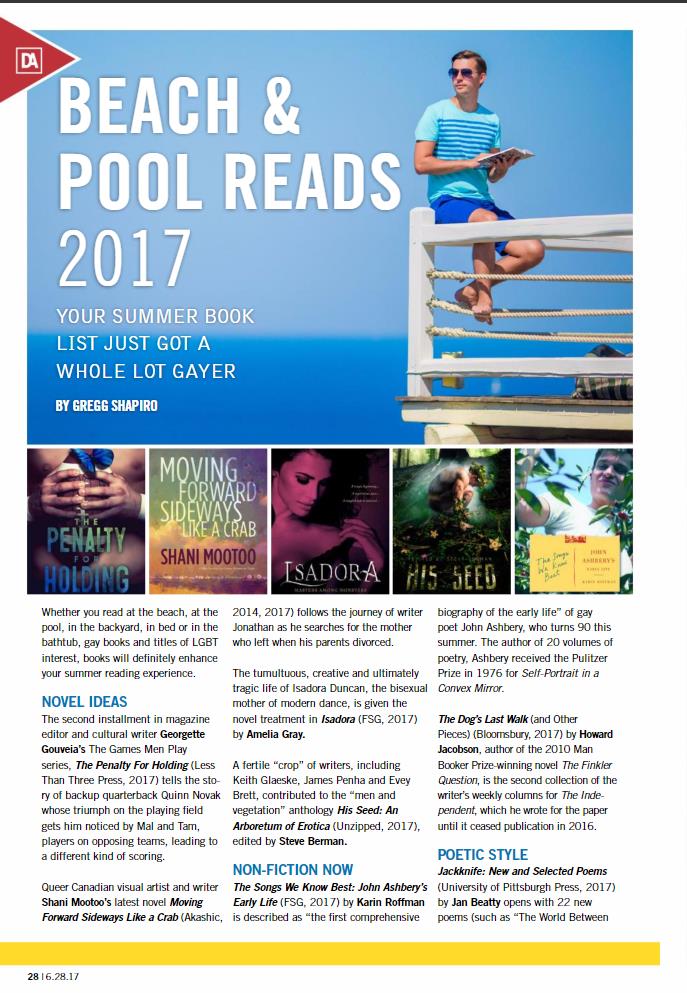
Whether you read at the beach, at the pool, in the backyard, in bed or in the bathtub, gay books and titles of LGBT interest, these books will definitely enhance your summer reading experience.
These are five books people are talking about this week -- or should be:

Karin Roffman. Farrar, Straus and Giroux, $30 (336p) ISBN 978-0-374-29384-0
Karin Roffman. Farrar, Straus and Giroux, $30 (336p) ISBN 978-0-374-29384-0
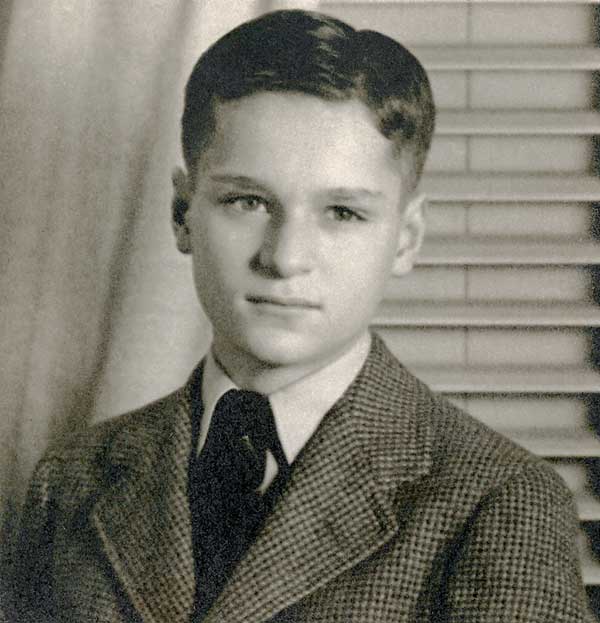
"This biography owes its existence to another stroke of luck. While the author was getting to know Ashbery, she found in his roomy old house early diaries and juvenilia that the author thought no longer existed. Without these she would have had to depend on the memories of people in their 80s. These diaries and early poems provide the keys to his development."
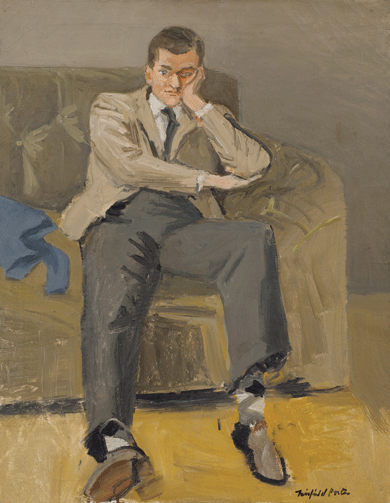
“What does it mean?????????????” John Ashbery wrote more than fifty years ago in The Tennis Court Oath, his second book of poems. The very exuberance of the punctuation may have sounded a note of caution for any readers who were looking for quick answers. (Perhaps thirteen question marks were an unlucky omen.) Since then, though, his work has been translated into twenty-five languages, and many would claim that a typical Ashbery poem speaks twenty-five languages. Even the poet has cast quizzical side-glances at his perplexing career. “I tell myself it all seems like fun and will work out in the end,” he noted in 1987. “I expect I will be asked a question I can answer and then handed a big prize. They’re working on it.” Several big prizes later, as he approaches his ninetieth birthday, Ashbery is still working on “it,” still wondering what “it” is. In 2006, when New York’s city council declared April 7 John Ashbery Day, the poet couldn’t resist asking: “But what does a John Ashbery Day mean? Are people going to stop and pause and think for a minute?”

John Ashbery, who turns 90 in July, is one of America’s most venerable, if challenging, poets. His work—which has won nearly every major poetry honor, beginning with the Yale Younger Poets Prize for his first book, Some Trees—is at once lyrical and disjunctive, as epigrammatic as it is puzzling. Karin Roffman opens a welcoming doorway into this poet’s life and work with her engaging, in-depth biography of Ashbery’s early life, The Songs We Know Best (FSG, $30, 336 pages, ISBN 9780374293840). A professor and literary critic, Roffman befriended Ashbery in 2005, and the book is drawn from hours of conversation with the poet as well as the unprecedented access he granted her to personal papers dating back to his childhood.
"In Roffman's (From the Modernist Annex) comprehensive biography of John Ashbery, a Pulitzer Prize-winning poet (for the collection Self Portrait in a Convex Mirror), readers get a view of the author through childhood to early adulthood for the first time. The 89-year-old Ashbery has been writing all of his life, and many of his poems and diary entries are included in this volume. There is some literary analysis done by the Roffman, but most of the work concentrates on the meanings behind the poems. Ashbery drew inspiration from his experiences, specifically the untimely death of his brother and the loss of relationships. Despite these tragic instances, he is known for his wit, focus, and self-awareness. Ashbery's career almost ended before it began though, when a supposed friend plagiarized his work and published it under a different name. Luckily for his readers, Ashbery persisted and became a literary legend. VERDICT Readers of Ashbery's work will enjoy Roffman's deep insight into the poet. Pictures throughout offer visuals of the people and places that shaped Ashbery's writing." —Natalie Browning, J. Sargeant Reynolds Community Coll. Lib., Richmond, VA"

The first “comprehensive” biography of the American poet’s early years.
From Publishers Weekly, 4/3/17: With immaculate detail and eloquence, Roffman (From the Modernist Annex) has written the first in-depth biography of one of the greatest poets of the 20th century. Her narrative follows Ashbery, who was born in 1927, up to 1955, when W.H. Auden awarded Ashbery's debut collection, Some Trees, the Yale Younger Poets prize. Roffman expertly analyzes his poems, revealing the nuanced imprint of his personal life on his work. She explores Ashbery's friendships (with painter Jane Freilicher and poets Frank O'Hara and Kenneth Koch, among others), his influences (including W.H. Auden and Marianne Moore), and his ventures into acting, prose writing, and painting. In addition to describing his triumphs, she reveals the darker parts of Ashbery's life: the childhood death of his brother, the specter cast by his era's homophobia, and his ongoing battle with depression. Roffman excels in her recreation of Ashbery's early years because she does not waver from firsthand sources and never attempts to interpret his life or poetry through pure speculation. Although at times this work is slow going and lacking in drama, it is an educational, comforting, inspiring book that will satisfy Ashbery's curious fans.